In Her Own Words
Bobby’s Story
Esther Rubenstein, recorded in Toronto on February 13, 2022
Esther Rubenstein, recorded testimony — Toronto, February 13, 2022
“Every step of the way, people helped us.”
A Village in Hungary
Esther was born on August 13, 1932 in Szatmárcseke, a small village in Hungary, the seventh of eight children — five brothers and two sisters. Her parents ran a dry goods store in the village. She remembered kindergarten, walking to school with her father, and the Tisza river that ran nearby. Life was primitive by later standards — no running water, no heat — but it was happy, and her parents were good parents.
A Mother’s Courage
In 1939 her father was drafted into the Hungarian army. A distant relative in America had sent sponsorship papers, and Esther’s mother — “an amazing woman” — drove a horse and buggy to the army camp outside the village and refused to leave until the captain saw her. She argued that with so many children at home, the army would be stuck supporting the family. The captain relented. Her father changed out of his uniform in the buggy, and instead of going home he was taken straight to the train station at Fehérgyarmat with papers and a change of clothes, on to Budapest, and on to America. Soldiers came knocking the next day. He was already gone.
A Protestant minister’s wife, a customer at the store, had quietly warned her mother: bad times were coming for the Jews, get out of Hungary if you can. In 1940 the three oldest children followed their father. In 1941 her mother began the process again for herself and the five children who remained.
The Thousand Pengő
Her mother sold the house and the family went into hiding with relatives in Fehérgyarmat, not allowed outdoors during the day. Every country along the route required a deposit of a thousand pengő per traveler, and she was one thousand short. The travel agent told her she would have to leave one child behind. She refused. The agent, moved, telephoned a Jewish industrialist named Manfred Weiss, who paid the difference for a woman he had never met.
When the tickets came through, it was a Friday, and her mother would not travel on Shabbos. A cousin who worked for the railroad told her the borders would close the next morning and put the children on the train himself. They left before sunrise — her mother wrapped in a peasant’s shawl, the children hidden under a tarpaulin in the bottom of a wagon.
Germany, Spain, and the Sea
The train carried them out of Hungary through Germany with the shades drawn. German soldiers took Esther and her little brother into another cabin, put bouquets of flowers in their hands, and photographed them for propaganda — proof of how well the Jews were being let out. From Germany they passed through Switzerland, France, and Spain, where they boarded a ship.
The captain saw a woman traveling alone with five children and demanded more money. Her mother collapsed. A German-Jewish passenger asked what was wrong, then went through the ship collecting the sum from other refugees until it was paid. Finding the family later stowed among the baggage in the hold, she confronted the captain again and got them two berths. The crossing took two weeks; the ship kept breaking down. Passengers fell ill from the food — her mother had packed hard-boiled eggs and salami for Pesach, so the children ate nothing else — and many were taken off in Cuba. When they tried to take her mother too, her fourteen-year-old sister refused to let them.
Ellis Island and Williamsburg
At Ellis Island her brother Mendy noticed a gentleman leave an attaché case behind in the crush of passengers and ran after him to return it. The man came looking for the family afterward: he was a diamond merchant, the case held his diamonds, and he told her mother the boy had saved his life. He gave her a business card. When her father, who had an apartment ready but no work, went to see him, the merchant taught him the diamond trade.
The Hebrew Immigrant Aid Society had helped bring the family over, and her father repaid every dollar out of his weekly wages. When the staff remarked that not everyone did, he answered simply that others would need the help too. Her mother threw a party the week the debt was paid — a moment Esther could still see clearly eighty years later. The two oldest boys served in the U.S. Army, one in Europe and one in the Pacific.
The whole immediate family got out. Her mother’s siblings who stayed in Fehérgyarmat, Budapest, and Debrecen did not; each family left one or two survivors. “Mind-boggling,” she said. Esther grew up in Williamsburg, Brooklyn.
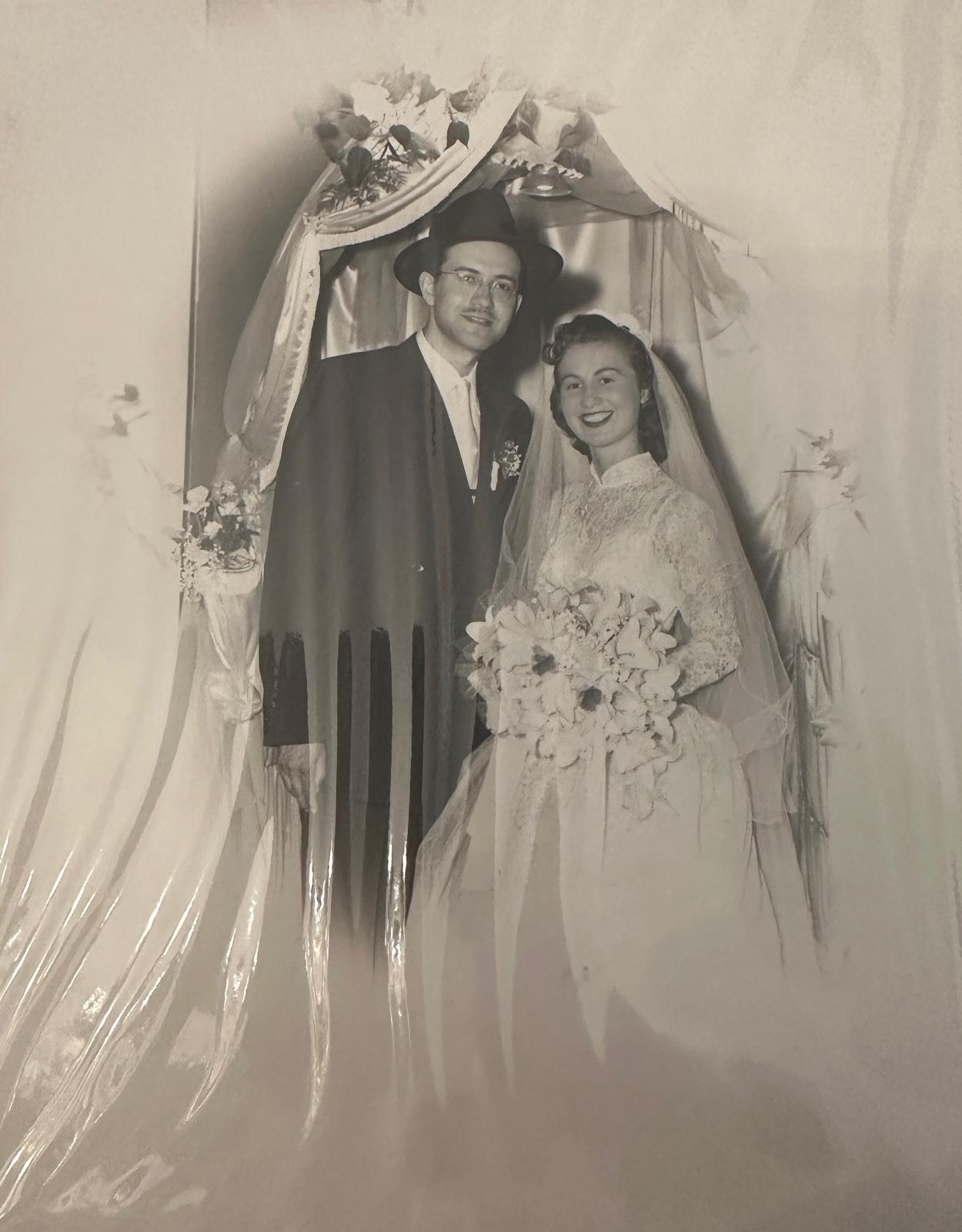
Esther and Izzy beneath the chuppah, 1953.
How She Met Zeidy
Esther worked the switchboard at a company importing sefarim and siddurim from Israel. Toronto’s Orthodox community was small then, so single young men would travel to New York to meet girls — and while they were there, the principal of a new Toronto school, Yesodei Hatorah, would ask them to collect donations. Two of them walked in one day asking to see the boss. When they left, her friend rushed out to the switchboard: she was dating the shorter one. Esther asked who the taller one was. That was Izzy.
“They not only collected money for the school,” she laughed, “they collected two brides.” They married in 1953 and settled in Toronto, where they raised three children and, in time, seventeen grandchildren and many great-grandchildren. Toronto was a good move, she said — she only ever missed her family in New York.
Adapted from Esther Rubenstein’s recorded testimony, interviewed by Adam Farberman in Toronto, February 13, 2022.